
You are here
 Angiosperm (2)
- Dicotyledon (8)
- Acanthaceae (2)
 Actinidiaceae (1)
- Anacadiaceae (1)
- Annonaceae (1)
- Apiaceae (2)
- Apocynaceae (1)
- Araliaceae (1)
- Asteraceae (5)
- Monocotyledon (3)

Strobilanthes cusia (Nees) J.B.Imlay
Nomenclature
-
Family: AcanthaceaeGenus: Strobilanthes
Media


SUMMARY
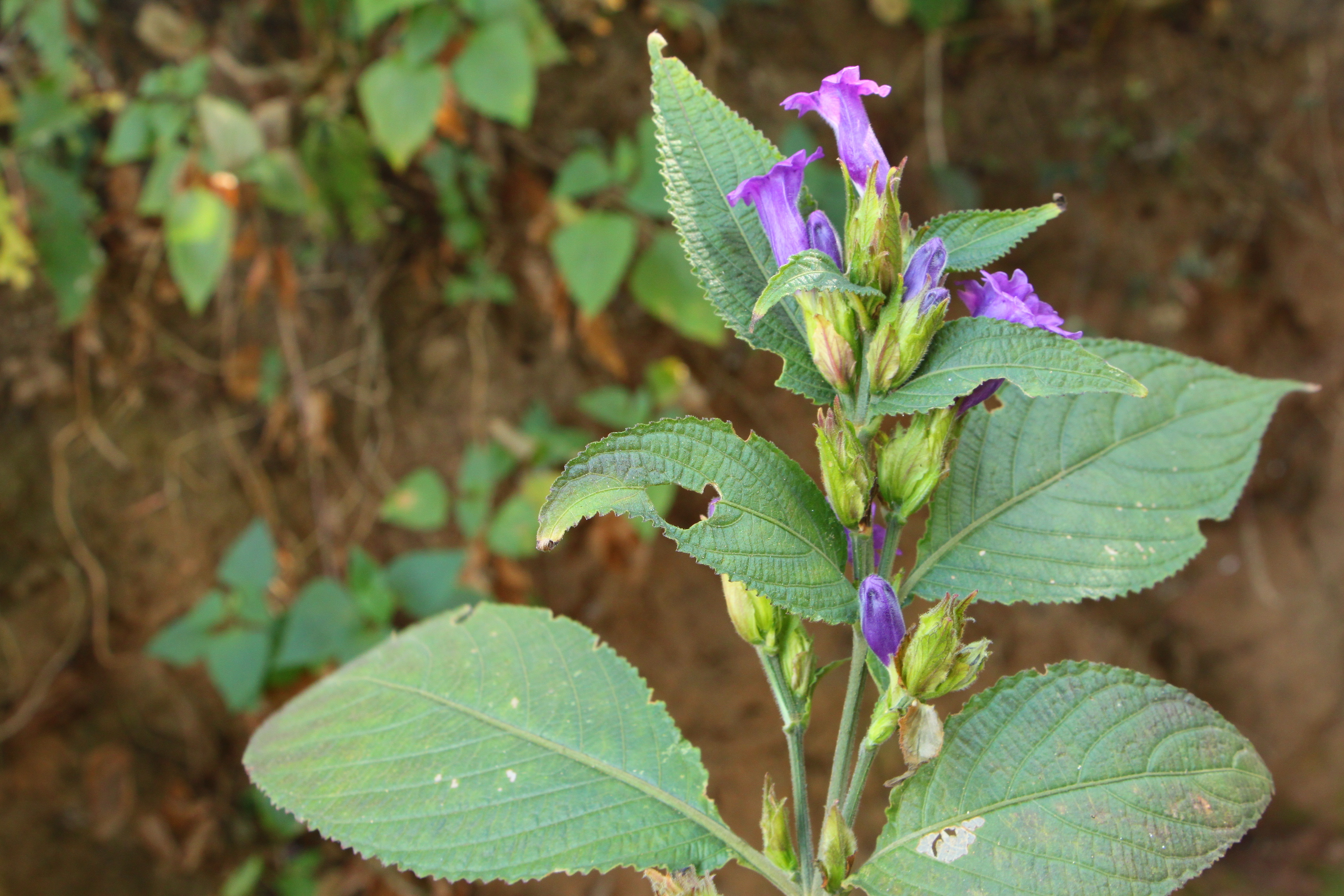
Herbs 0.5-1.5 m tall, erect, branched, drying blackish, isophyllous to weakly anisophyllous. Stems glabrous or minutely brown puberulent. Petiole 0.5-7 cm; leaf blade elliptic to ovate, 4-20 × 2-9 cm, both surfaces glabrous or abaxially minutely puberulent along veins, abaxially paler green, adaxially dark green, secondary veins 7-9 on each side of midvein, base attenuate, margin serrate, apex acute. Inflorescences terminal or axillary, bracteate spikes, 1-6 cm, often aggregated to form a leafy branched panicle; peduncle 1-12 cm; bracts leaflike, petiolate, oblanceolate, obovate, or spatulate, 1.2-2.5 cm, basally usually sterile; bracteoles linear-oblanceolate, 2-3 mm, deciduous before bracts. Calyx 0.8-1.5 mm in flower, accrescent to ca. 2.5 cm in fruit, minutely puberulent, 5-lobed almost to base; 4 lobes linear-lanceolate, apex acute to obtuse; 1 lobe oblanceolate and much longer. Corolla blue, 3.5-5 cm, straight to slightly bent, outside glabrous; tube basally cylindric and ca. 3 mm wide for 1-1.5 cm then slightly curved and gradually widened to ca. 1.5 cm at mouth; lobes oblong, ca. 9 × 9 mm, subequal. Stamens 4, included; filaments glabrous, shorter pair ca. 3 mm, longer pair ca. 7 mm; anther thecae oblong, ca. 3 mm; pollen type 4. Ovary oblong, apex puberulent with few gland-tipped trichomes; style ca. 3.2 cm, glabrous. Capsule 1.5-2.2 cm, glabrous, 4-seeded. Seeds ovate in outline, ca. 3.5 mm, covered with appressed trichomes; areola small. Fl. Jul-Feb, fr. Dec-Feb. 2n = 16, 32.